Two Keys, One Lock: The Real Difference Between Cetuximab and Panitumumab
May 1, 2026The 70-Year-Old Drug That Still Holds Cancer’s Feet to the Fire
Oncology · Pharmacology · Patient Safety
There is a drug quietly running through the veins of cancer patients in virtually every oncology infusion center on earth. It has been doing so since 1957. It predates MRI machines, targeted immunotherapy, and the sequencing of the human genome. And yet, despite its age, 5-Fluorouracil — universally known as 5-FU — remains one of the most biochemically sophisticated weapons in the oncologist’s arsenal. The reason is deceptively simple: it does not attack cancer in one way. It attacks cancer in two.
Understanding how — and why — that matters is not just an academic exercise. It is the difference between a drug that works and one that fails, between a patient who responds and one who suffers a devastating, preventable toxicity.
A Tale of Two Mechanisms
Delivery method is not a logistical detail with 5-FU. It is the mechanism itself. As experts debate bolus vs. continuous-infusion 5-FU, the core distinction is this: a rapid bolus injection — active in the bloodstream for as little as 15 minutes — acts primarily by flooding cancer cells with a counterfeit version of uracil, a molecule called fluorouridine triphosphate (FUTP), which gets woven directly into RNA. The cell’s protein-building machinery seizes. Ribosomes malfunction. The factory floor grinds to a halt.
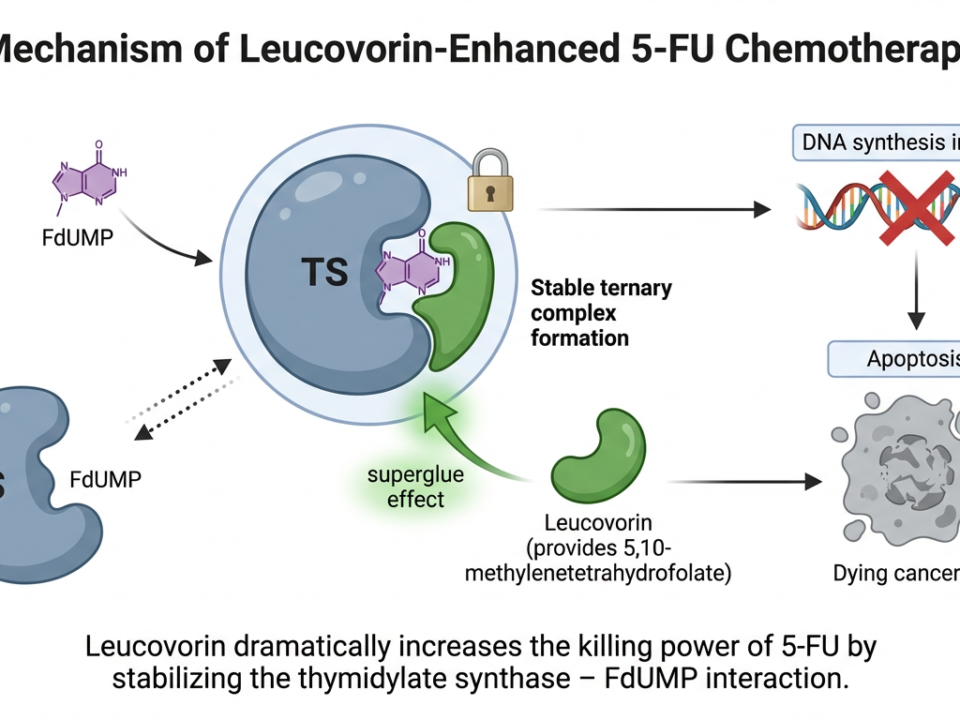
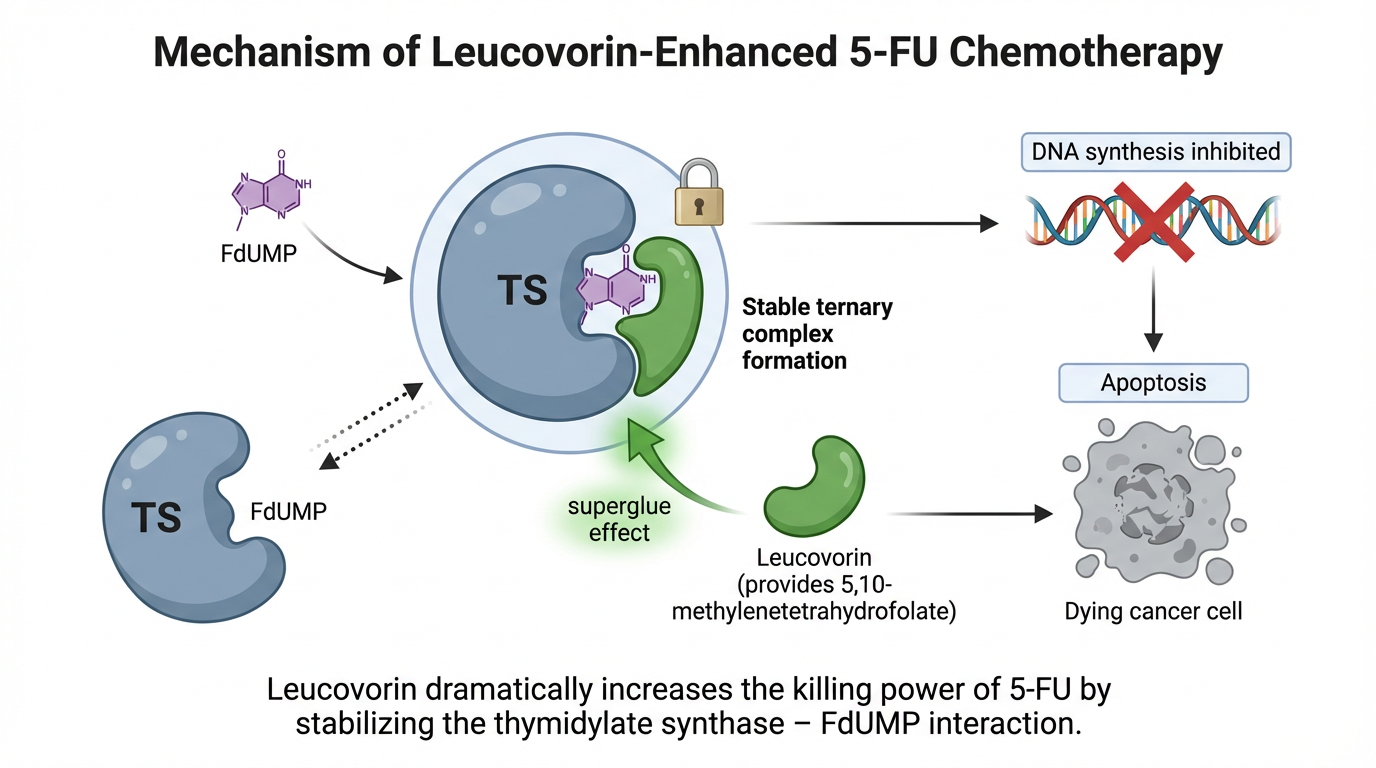
But the bolus burns fast. The 5-FU elimination half-life of 6–20 minutes means that within an hour, the plasma is largely clear. To sustain cytotoxic pressure on the DNA side of the equation, oncologists pivot to the 46-to-48-hour continuous infusion — and here the primary villain shifts. The metabolite FdUMP locks onto an enzyme called thymidylate synthase (TS), the cell’s sole factory for producing the building block of DNA. According to FUTP RNA incorporation and FdUMP thymidylate synthase inhibition research published in the Annals of Oncology, all three active metabolites — FdUMP, FUTP, and FdUTP — play distinct roles in this layered cytotoxic assault.
High peak concentration → FUTP incorporated into ribosomal, messenger & small nuclear RNA → protein synthesis disruption → immediate cytotoxic event
Sustained plasma levels → FdUMP binds thymidylate synthase → DNA synthesis blockade maintained across full cell cycle → thymineless death
The Superglue That Seals the Trap
FdUMP binding to TS alone is not enough. Left to its own devices, the bond is reversible — a key that fits but won’t quite turn. This is where leucovorin, also called folinic acid, enters. It supplies the folate cofactor 5,10-methylene tetrahydrofolate, which stabilises the formation of a covalent, ternary complex between FdUMP and the enzyme. As leucovorin stabilises the covalent ternary TS complex — a finding confirmed in the British Journal of Cancer — the enzyme goes from temporarily inconvenienced to permanently disabled.
There is a cruel irony embedded in this chemistry. The very act of trapping the enzyme triggers a resistance response: the ternary complex, once formed, can no longer bind to TS’s own messenger RNA, eliminating a natural feedback brake. The cell senses the blockade and floods itself with fresh TS protein — a desperate attempt to outproduce the drug. The 48-hour infusion exists, in part, to outlast exactly this gambit. Every newly minted enzyme molecule emerges only to be captured by the steady stream of FdUMP and leucovorin waiting for it.
The Genetic Minefield: DPD Deficiency
None of this biochemical elegance matters if the patient cannot clear the drug. The enzyme dihydropyrimidine dehydrogenase — DPD, encoded by the DPYD gene — is responsible for catabolising more than 80% of administered 5-FU. When it is absent or impaired, the “flash flood” of the bolus never recedes. As universal DPYD testing prior to 5-FU and capecitabine therapy advocates have documented, severe toxicities — grade 3 or higher — occur in 30 to 40 percent of fluoropyrimidine patients overall, with mortality around 0.5 to 1 percent, largely attributable to this deficiency.
in European-ancestry patients
— no safe dose exists
For patients with complete deficiency — homozygous for no-function variants — there is no negotiating with dosage. The FDA is unequivocal: no safe dose exists. If the worst occurs and a patient receives 5-FU without adequate DPD function, one rescue exists: uridine triacetate, a prodrug that floods the body with competing uridine substrate. It must be administered within 96 hours of the last dose to be effective.
The IDEA That Changed Adjuvant Therapy
Even the question of how long to treat has been upended by hard evidence. The IDEA collaboration — a pooled analysis of 12,834 patients across six randomised phase III trials — examined whether three months of adjuvant chemotherapy could match six months for stage III colon cancer. The answer split cleanly along regimen lines: for CAPOX, three months was non-inferior to six months. For FOLFOX, six months retained a meaningful edge, particularly in high-risk patients.
For patients, the real-world consequence of that finding is profound. Cutting treatment from six months to three slashed grade 2 or higher neurotoxicity from 47 percent down to just 16 percent — a difference that separates permanent nerve damage from a functional life after treatment.
Seventy Years In, Still Revealing Its Secrets
5-FU was synthesized and 5-FU patented by Charles Heidelberger in 1957. The world it was born into had no oncogenes, no biomarkers, no concept of personalised medicine. And yet here it stands, the backbone of FOLFOX, FOLFIRI, and FOLFIRINOX — the alphabetic pillars of gastrointestinal oncology. It treats colorectal, breast, head-and-neck, and gastric cancers. It has outlasted dozens of drugs that arrived with greater fanfare.
What the last decade of research has made clear is that the drug’s longevity is not merely institutional inertia. It is biochemical depth. The dual-delivery strategy — bolus for RNA disruption, infusion for sustained DNA blockade — represents a form of temporal targeting that newer, more glamorous agents often cannot replicate. The leucovorin cofactor turns a reversible inhibition into a permanent one. The antidote exists but demands a 96-hour window. The patient’s genome, specifically at DPYD, can make a standard dose lethal.
This is not an old drug running on borrowed time. It is a molecule that the medical community is still learning to use with precision. And in an era defined by genomic testing, microsatellite instability profiling, and treatment-duration trials enrolling tens of thousands of patients, that learning has never moved faster. The 70-year-old drug, it turns out, still has things to teach us.
Sources: Annals of Oncology · PMC / British Journal of Cancer · PubMed · NCODA · NEJM · JNCI · ASCO Post · Health Canada